

History of the Nissan S13
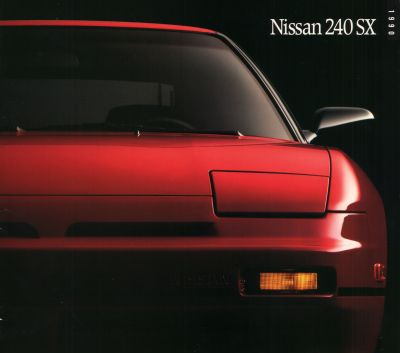
The History of the S13 starts in the late 80s
The history of the S13 starts in 1988 in Japan when it was released. The S13 initially got sold in Japan with two engine options. You either got the CA18DE or the CA18DET, the latter being the turbocharged version. The naturally aspirated version of the car produced a measly 131hp whilst its turbocharged brother made a more respectable 169hp. Suffice to say, it’s the turbocharged version that you wanted.
It wasn’t long before the tiny 1.8 liter engine got replaced with a more modern variant in 1991 called the SR20. Again this engine came either naturally aspirated in the form of the SR20DE or a turbocharged version called the SR20DET. Unlike the CA18, the SR20 was an aluminum block so even though it had a bigger engine capacity, the engine itself was lighter. The SR20DET made just over 200hp which made the S13 quite fast in the early 90s.
In Japan, the car got offered in a large range of trim packages with many additional options. Japan even got some very rare limited edition trim packages. The S13 in Europe didn’t receive any trim packages, but dealers offered some additional options. There are variations of the options available depending on the country the car got sold in. The common things you will see on European S13s are heated rear windows, electric mirrors, central locking, power windows, Leather steering wheels, ABS, tape or CD players, and AC. Most of these were standard options. All European cars came with a manual 5-speed transmission. HICAS was not available in Europe.
In the USA the S13 had a standard, SE, and LE level trim. The SE got alloy wheels, a sunroof, a rear spoiler, a leather shift knob and steering wheel, power windows, central locking, electric mirrors, and cruise control. The coupe version also got a Heads-Up-Display (HUD) and digital tachometer, which from a technological point of view was ahead of its time. An electric sunroof was optional on the SE.
The LE trim was more luxury-oriented and featured all of the above in addition to leather seats, lumbar support, AC, and again an optional slideable sunroof.
Besides that, the S13 also had the option of a Viscous Limited Slip Differential (VLSD) and four-wheel steering in the form of a HICAS system. The HICAS system was revolutionary and also seen on a couple of other cars Nissan produced during the late 80s and early 90s. Nowadays people often choose to delete the HICAS system entirely because it is electronically complex and prone to leak after many years of service.
Different names in different regions
As you probably know the S13 is not the common name for the car and you won’t find S13 on any of its stickers or badges. The S13 is known under various names depending on the market it was sold in.
In Japan the car was known as a Nissan Silvia, a mythical name derived from a nymph called Sylvia who served the greek goddess of the hunt and chastity. The car came in two flavors, a hatchback, and a coupe. The hatchback is known in Japan as the 180sx, presumably because of its 1.8 liter engine capacity when the car first launched. The coupe version holds the name Silvia.
Europe only got the hatchback which was sold under the name 200sx. It came with the earlier CA18 engine instead of the more powerful Sr20 so the name 200sx is somewhat confusing. Europe never got a coupe version much to the chagrin of many European S13 enthusiasts.
In the USA the Silvia got rebranded as a 240sx and sold with a 2.4 liter KA24E engine. As the name implies, this was a single overhead cam naturally aspirated engine. Not quite the sporty engine that the USA hoped for despite its larger engine capacity. In 1991 the KA24 got an update and received dual overhead cams and 4 valves per cylinder. The engine was a bit more punchy but generally speaking still underwhelming compared to its European and Japanese counterparts. Nowadays the Ka24 is often turbocharged or swapped out for a more potent engine. The USA was however lucky enough to get both a hatchback and a coupe version of the car. The coupe version was however not the same as the Japanese beloved Silvia. It was a coupe with the 180sx front end transplanted onto it.
The S13 got various facelifts over its lifetime
The S13 received multiple facelifts over the years and the names that people refer to them can be confusing.
Zenki’s
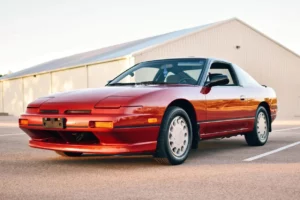
The early models are called “Zenki” models, which means “first” in Japanese. This variant is also often referred to as a “Pignose” because of the shape of the front bumper.
Chuki’s
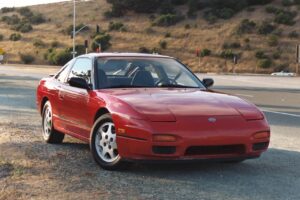
Between 1991 and 1994 the S13 is referred to as a chuki which means “Middle period” in Japanese. This variant is sometimes called a sharknose because of its sleeker front bumper design. In the USA this model also received a slightly updated version of the KA24. In Japan this was the time that the S13 would start receiving the mighty SR20.
Kouki’s
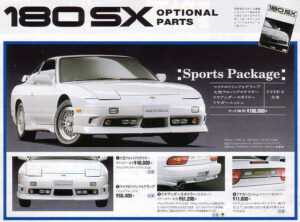
And finally, between 1994 and 1998 the car got referred to as “Kouki” meaning the “last period” in Japanese. The kouki version of the car was only sold in Japan because in all other markets the S13 got replaced by its younger brother the S14 in 1994. In Japan, the S13 was sold alongside the S14 for several years. These kouki models are highly sought after because they have arguably the best design out of all facelift models. The front bumper, combined with its sleek side skirts, sporty rear spoiler, and gorgeous taillights make it a sight to behold.
The S13 was loved by many
When the Nissan S13 launched it was an immediate hit in Japan, not just among sports car enthusiasts, but specifically drifters. The front engine rear wheel drive layout combined with a somewhat long wheelbase made the car perfect for sliding around corners in style. The car was also quite affordable and cheaper than other Nissan offerings such as the Skyline GTR or Z models. On top of that, the SR20 engine turned out to be extremely capable in the hands of good tuners. Even minor modifications made the SR20 capable of 350 horsepower (yes that’s almost double its original power). The SR20 has proven itself over the last 30 years and even to this day remains one of the favorite engine swaps for no Japanese S13s.
Worldwide success, and where we are today
Over the span of almost 10 years, Nissan would sell over 250.000 S13s globally. The car has an almost cult following and we don’t see its popularity decline anytime soon.
The cars got so cheap during the late 2000s and early 2010s that you could pick up a clean example for around $3000. Because they were so cheap and plentiful, most of them didn’t have an easy life. Many have been destroyed drifting, rusted away, or parted out. Clean examples are hard to come by and if you do find one, expect to pay a pretty penny.
